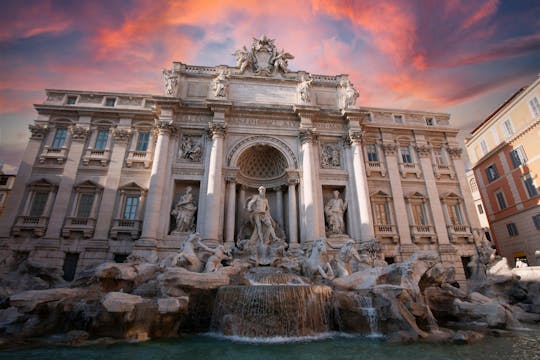
The Trevi Fountain, the world's most renowned fountain, marks the end point of the Vergine aqueduct. Its name, documented since the Middle Ages, either originates from a local term used in the mid-12th century (regio Trivii), or refers to the triple water outlet of the original fountain.
In 1640, Pope Urban VIII commissioned Gian Lorenzo Bernini to design a new fountain as part of the square's expansion. The design featured an exedra base with a basin leaning against buildings that were later incorporated into the Poli Palace. However, the current Trevi Fountain owes its construction to Pope Clement XII. In 1732, he held a competition attracting leading artists of the time. The winning design was by architect Nicola Salvi, chosen for its monumental scale and minimal impact on the palace behind it.
The fountain is designed like a triumphal arch with a deep niche. This setting is brought to life by numerous sculptural representations of plants and the dramatic flow of water. At the centre, you'll see the statue of Oceanus driving a chariot shaped like a shell, pulled by one fierce and one placid horse, both restrained by two tritons. The façade is adorned with reliefs depicting allegorical figures symbolising the beneficial effects of water. Salvi's masterpiece harmoniously blends history and nature, reflecting the ideals of the emerging Enlightenment. The construction was finalised by Giuseppe Pannini, who subtly modified the central basins to regularise the cliff.

 Skip-the-line ticket
 Guided tour