Countryside in Hammamet
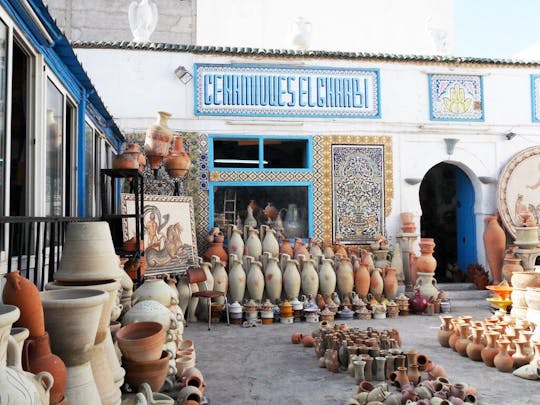
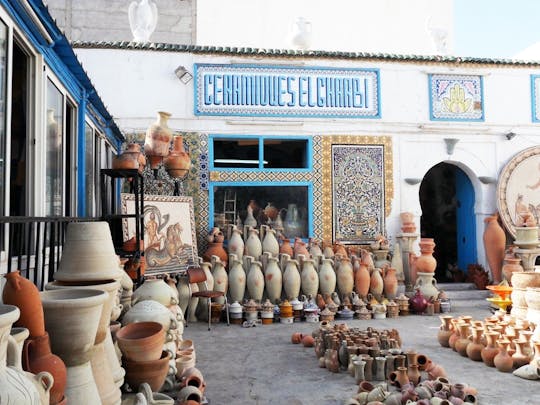
Nabeul Market sprawls through the coastal town of Nabeul, near Hammammet in Tunisia. It's one of North Africa's largest market and you can buy pretty much anything there. This authentic and vibrant shopping experience is renowned for traditional ceramics, leather goods, spices and textiles – it's a treasure trove of handicrafts and local artisanal products.As well as being a great place to pick up souvenirs, Nabeul market is also fantastic for trying the flavours of Tunisia. There's a large section for fresh produce and plenty of street foods to sample, so look out for treats like fresh local fruit, aromatic spices, olives, honey, traditional pastries and top quality Tunisian dates.You'll have the chance to engage with friendly local vendors at the market, who are always ready to share stories, traditions, and insights about their products. Feel free to haggle and negotiate prices, as it's all part of the fun. Nabeul market is also an immersive cultural experience, and you'll see lots of local people doing their shopping here, too.
en
en
Ancient Carthage, Sidi Bou Said and Bardo Museum tour with lunch
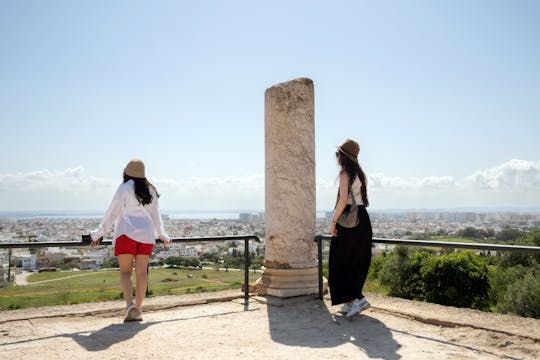
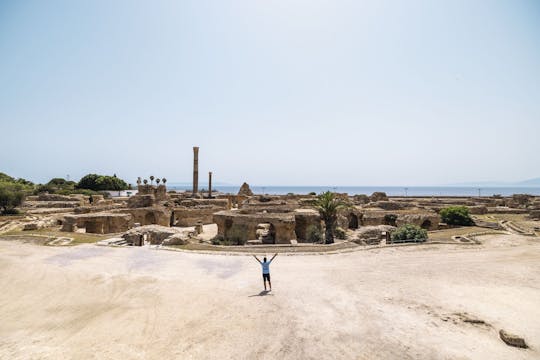
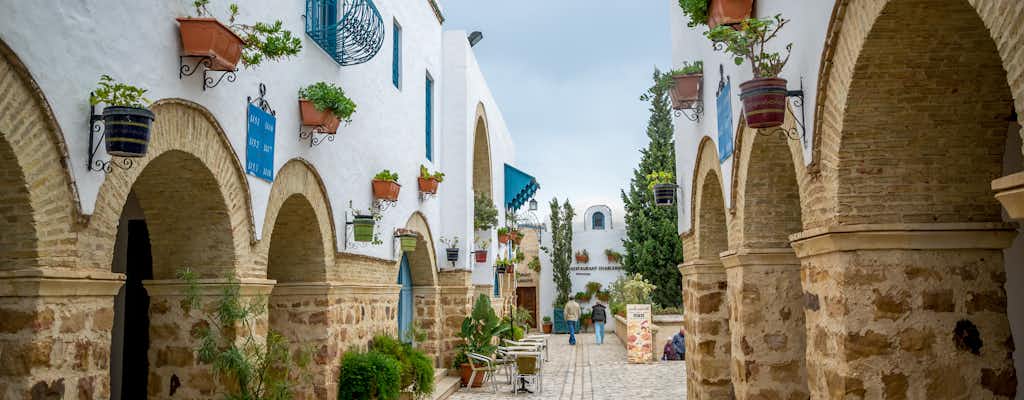
Carthage was the capital of ancient Rome's greatest rival and the site of a titanic clash of civilisations. Today, its ruins bear testament to Rome's ultimate victory, as you'll discover during this tour, which also takes in Sidi Bou Said and a stop at the Bardo Museum. Mariam, one of our expert local guides, says "a good place to get your bearings in ancient Carthage is Byrsa Hill. It's a bit of a climb but the view over the archaeological site, the city and the bay are absolutely worth it."You'll start the morning with a visit to the Bardo Museum, home to a magnificent collection of mosaics recovered from Roman villas across the region. Then, it's off to Carthage. Under renowned military leaders such as Hannibal, this site was one of the greatest powers of the classical world. Exploring with a guide gives you the historical background and the local perspective on the story of Carthage. Begin with a panoramic view of the Amphitheatre of Carthage, before continuing to Byrsa Hill, the ancient heart of the Punic city – this is where you'll catch those epic views Mariam mentioned. Then, it's on to see the Baths of Antoninus, which were among the largest thermal baths in the Roman Empire.After a traditional Tunisian lunch, you'll visit Sidi Bou Said, a clifftop village of cobbled alleys, whitewashed houses and famous sky-blue doors and window shutters. The blue and white colour scheme has echoes of the Greek islands, and contrasts with the Mediterranean Sea beyond. You'll discover the village's history and find out why so many artists have been inspired by it over the years. What is the itinerary for this experience? The itinerary for this experience is... - 7:20am – departure from the first hotel - 10:00am – arrival at the Carthage archaeological site - 12:30pm – lunch - 3:00pm – visit to the village of Sidi Bou Said - 4:30pm – departure from Tunis to Hammamet - 6:00pm – return to the last hotels Please note, the times and schedule may vary on the day
en
en
Tunisian Sahara two-day tour of Hollywood film hotspots
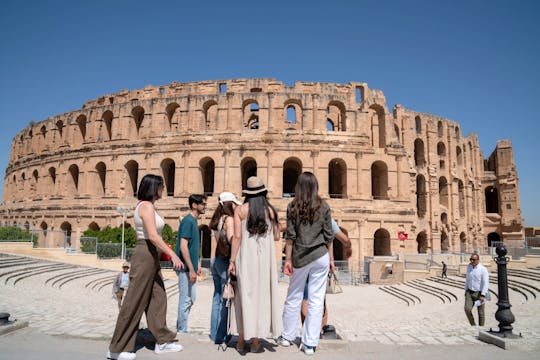
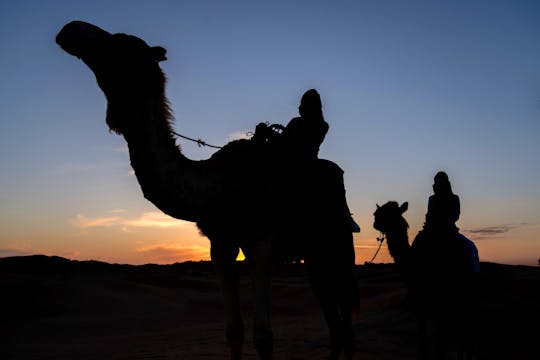
Imagine a place where the sands of the desert have been touched by the magic of Hollywood stardust. You've found it with this two-day tour, which'll show you some of Tunisia's most famous film locations. You'll visit a Roman amphitheatre, explore underground cave homes, cross a vast salt lake and discover a legendary film set on the fringes of the Sahara. Hamdi, one of our expert local guides, says, ‘Between Matmata and Douz, there are endless "ergs" – sand dunes – in the restless desert. This desert is not a dead entity, it's even cultivated in places by those who inhabit it. The sands come alive according to the seasons.'Embark on your sandy adventure at El Djem Amphitheatre. One of the best-preserved Roman arenas in the world, this UNESCO World Heritage Site was featured in Gladiator and once held crowds of 35,000 spectators for gladiatorial contests. You'll then head to Matmata, where you'll have lunch and visit the underground cave homes that starred as Luke Skywalker's home in the Star Wars saga. Finish the day in the oasis town of Douz, known as the gateway to the Sahara, for an overnight stay. This is a great spot to take an optional camel or carriage ride in the desert.After breakfast, you'll cross Chott el Jerid, Tunisia's largest salt lake, where shimmering white salt crystals create a surreal landscape. Then, jump into a 4x4 for a ride to Onk Jemal, where you'll discover the Star Wars film set city still standing among the desert dunes. After lunch in Gafsa, you'll round off the tour with a photo stop overlooking Kairouan's Great Mosque, where you can admire the distinctive skyline of one of Islam's holiest cities.
en
en
Highlights of Sousse & Monastir
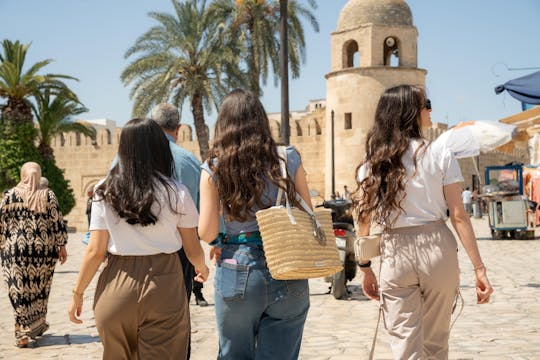
Like shimmering mirages on the desert horizon, Sousse, Port El Kantaoui and Monastir are a trio of Tunisia's must-sees. Explore ancient fortresses, atmospheric medinas and the magnificent Bourguiba Mausoleum on this full day tour.Your first stop is Monastir. Bring the past to life and admire ancient architecture in the old quarter, before seeing the intricate minarets, mosaics and archways beneath the golden dome of Bourguiba Mausoleum. The city's star turn however, is the Ribat Fortress – an early Islamic stronghold that has guarded the waterfront for over a thousand years.Next up is Sousse, a city where history is etched into every cobblestone. Wander through the bustling medina, a treasure trove of trinkets and handicraft, then make your way to the contemporary marina of Port El Kantaoui. Here, you'll round off the tour with some free time to meander among the luxury yachts dotting the harbour.
en
en
Guided tour of Tunisian Atlas Mountain villages from Hammamet
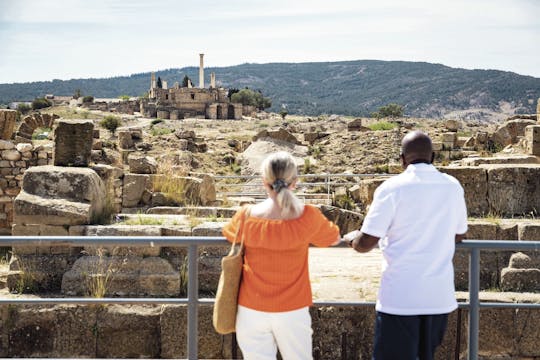
The remote Berber villages of Tunisia's Atlas Mountains are about as far away from modernity as you can get. On this tour, you'll be whisked away in an off-road vehicle into these highlands to visit the Roman ruins of Zaghouan and Uthina as well as the mountain village Zriba El Alya. Mohamed, one of our expert local guides, says, ‘Zriba El Alya was deserted in the 1960s after the development of the new town in the plain. But four to five families still live here among the ruins, which now mostly serve as sheepfolds.'Your Atlas adventure begins at the little-visited Uthina, which is still being excavated by archaeologists. Admire the amphitheatre – up to 16,000 spectators watched gladiatorial combats – the magnificent mosaics unearthed in villas and more. The Roman theme continues at the Zaghouan Water Temple, site of an ancient sacred spring. Its location, fringed by pine trees at the foot of a mountain, gives an indication of just how revered it was by the ancients.We'll then drop into a Zaghouan eco-lodge set in beautiful gardens for a Tunisian pastry cookery demonstration and a typical lunch made from locally sourced ingredients. What's more, your visit contributes to the local community and economy. The day's final stop is the half-ruined Berber village of Zriba El Alya, which lies on a craggy ridge. It boasts superb views of Djebel Zaghouan, the fourth highest peak in Tunisia, and the coastline. Your guide will fill you in on the story behind its hard-to-reach location.
en
en
Kairouan Holy City and El Jem tour from Hammamet
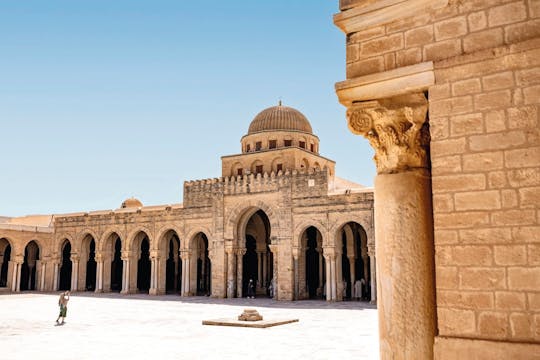
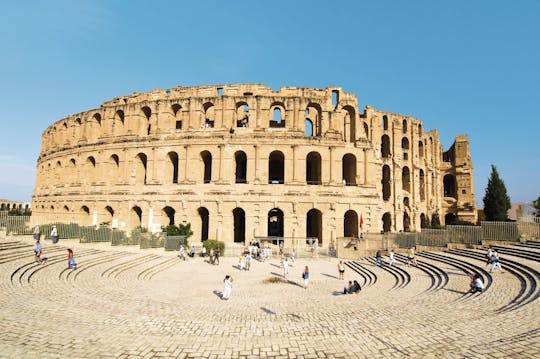
Kairouan's old town echoes Tunisia's past, with a peaceful air that hasn't changed much in centuries. On this tour, you'll discover history-drenched locations such as the Roman colosseum of El Djem, Africa's second-oldest mosque and the medina of Kairouan. Karim, one of our expert local guides, says "Kairouan is Tunisia's holiest destination, renowned for its fine Islamic architecture. The interior of the Great Mosque is all endless pillars and arches, colourful carpets, and chandeliers shaped like pine trees that add to the beauty of the space. Even the drains are decorated with intricate stonework."We'll start off in the walled city of Kairouan. Protected by sandstone walls, the old town offers medina is a maze of narrow streets, whitewashed houses with brightly painted shutters and brick-laid archways, perfect for exploring. Then you'll visit Kairouan's unmissable Great Mosque - considered one of the finest examples of Islamic architecture in the region. As well as the mosque's splendid interior, the complex also features a large prayer hall, an arcaded courtyard, and a minaret.Another important site in Kairouan is the Sidi Sahbi mausoleum, known for its beautiful tilework and stucco decorations – it's a popular site for pilgrimages. Next, there's a stop for lunch before visiting El Djem amphitheatre, the third-largest built by the Romans. During its heyday, up to 35,000 spectators would pack its steep stands to watch gladiatorial fights.
en
en